
Millions of people across Australia heard an unexpected siren from their phones on Monday, 27 July 2026, as the country carried out the first nationwide live test of AusAlert, its new emergency warning system.
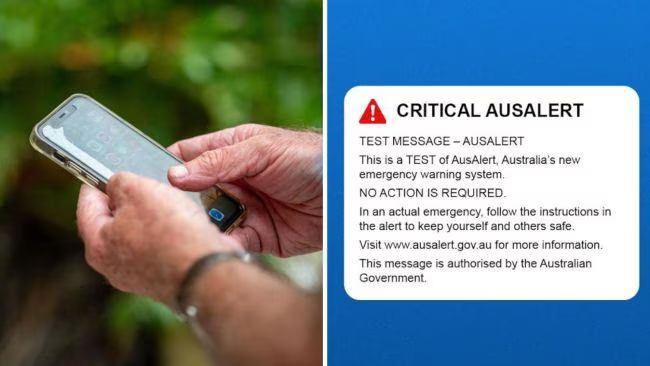
The 10-second alert appeared on compatible smartphones, smartwatches and tablets across every Australian state and territory. Even devices set to Silent or “Do Not Disturb” sounded the warning, catching many people by surprise.
The exercise was not linked to any real emergency. Instead, it was designed to check whether Australia’s new cell broadcast system can quickly deliver life-saving alerts during bushfires, floods, cyclones and other major disasters before the service officially launches in October 2026.
What Was the AusAlert Test?
The nationwide test was organised by Australian emergency authorities in partnership with state governments and major mobile network providers.
People carrying compatible mobile devices anywhere in Australia received a test notification at different times depending on their time zone.
Test Schedule
- 2:00 PM AEST: New South Wales, Victoria, Queensland, Tasmania and the Australian Capital Territory
- 1:30 PM ACST: South Australia, Northern Territory and Broken Hill
- 12:00 PM AWST: Western Australia
- 11:00 AM CXT: Christmas Island
The message clearly stated that it was only a test and that no action was required.
Authorities also advised support organisations working with domestic violence victims to inform people who keep hidden or emergency phones. Those devices were recommended to be switched off or placed in Airplane Mode during the test if receiving the alert could create a safety risk.
How Does AusAlert Work?
Unlike traditional emergency text messages, AusAlert uses cell broadcast technology.
Instead of sending millions of individual SMS messages, mobile towers transmit one emergency signal to every compatible device connected to that tower at the same time.
This allows warnings to be delivered within seconds, even when mobile networks are busy.
Some of the main advantages include:
- Faster delivery during large-scale emergencies.
- Reliable operation even when phone networks are congested.
- The ability to target warnings to specific suburbs or affected areas.
- Alerts that can override Silent mode and “Do Not Disturb” settings.
- No requirement to collect phone numbers or personal information.
Because the system works as a one-way broadcast, authorities do not know who received the alert or where individual users are located.
Why Australia Is Introducing AusAlert
Australia regularly experiences natural disasters, including bushfires, floods, cyclones and severe storms.
Previous emergencies showed that traditional SMS warning systems could become delayed when millions of people were trying to use mobile networks at the same time.
Cell broadcast technology solves that problem by sending a single message to every compatible device within the affected area almost instantly.
The technology also allows emergency services to warn only the communities that are actually at risk instead of sending alerts across an entire city or state.
What Authorities Will Review After the Test
The July trial was an important step before the nationwide rollout planned for October.
Emergency agencies and mobile network operators will now review how well the alert performed across different regions.
The assessment is expected to focus on:
- Whether alerts reached compatible devices as planned.
- Coverage in remote and regional areas.
- Performance across different phone models and operating systems.
- Any technical issues reported by users.
Some older phones displayed default international emergency alert labels because of differences in software versions. Devices that were switched off, in Airplane Mode or outside mobile coverage did not receive the notification.
Road safety authorities also reminded drivers not to use their phones while driving, even if an emergency alert appears on the screen.
Why This Matters
Although the July alert was only a test, it marks a major upgrade to Australia’s emergency warning capability.
When AusAlert officially launches later this year, it is expected to play a key role during life-threatening events by delivering urgent instructions much faster than traditional text messaging.
For people living in bushfire-prone regions or flood-affected communities, receiving warnings within seconds could provide valuable extra time to act.
Frequently Asked Questions
Why didn’t my phone receive the AusAlert test?
Your device may not have received the alert if it was switched off, in Airplane Mode, outside mobile coverage or running software that does not fully support cell broadcast alerts.
Can I opt out of AusAlert?
No. Emergency alerts are designed to reach as many people as possible during life-threatening situations and generally cannot be disabled through normal phone settings.
Does AusAlert track my location?
No. The system broadcasts a message from nearby mobile towers and does not collect phone numbers, identities or GPS location data.
Will the alert sound if my phone is on Silent?
Yes. Critical emergency alerts are designed to override Silent mode and “Do Not Disturb” settings on compatible devices.
When will AusAlert officially launch?
Following the nationwide testing programme, Australian authorities plan to roll out AusAlert across the country in October 2026.


- Ion Exchange Shares Slide 8% After Q1 Profit Plunges 92%: Here’s What Happened
- Swiggy’s FY31 Roadmap Sends Shares Higher: What Investors Need to Know
- Titan Stock at All-Time High: What’s Fueling Investor Optimism Before Q1 Earnings?
- Could Hardik Pandya Captain KKR in IPL 2027? Here’s Why the Move Is Being Discussed
- 10 Best Indian Movies to Watch This Independence Day 2026