
Website: BollywoodView.com
Author: AK
Residents across New South Wales’ Central West were jolted awake after an early morning earthquake sent mild tremors through several communities. The quake, which struck before sunrise, was felt in parts of the region, prompting many people to report shaking, rumbling noises, and vibrating windows.
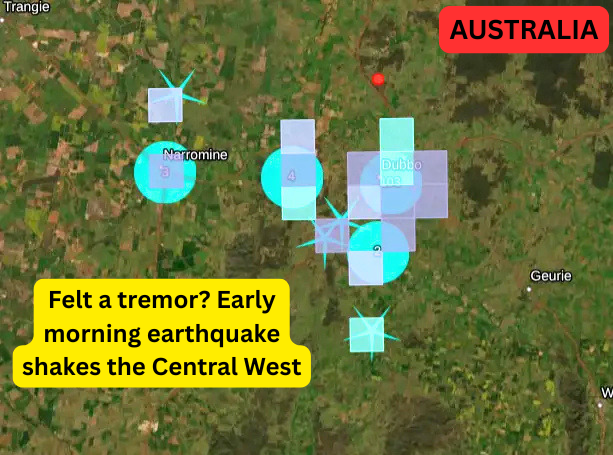
Fortunately, there have been no immediate reports of injuries or significant damage, but the tremor has once again highlighted that earthquakes, although relatively uncommon, do occur in parts of inland New South Wales. According to Geoscience Australia, the earthquake was a magnitude 3.4 event that occurred near the Cadia Gold Mine, south of Orange, at a depth of about 1 kilometre.
What Happened?
The earthquake struck at approximately 5:45 AM local time, waking many residents in and around Orange, Millthorpe, Blayney, Oberon, and nearby communities.
People described hearing a loud rumble before feeling several seconds of shaking. Some initially believed a large truck was passing their homes, while others thought it was blasting activity from nearby mining operations.
ALSO READ : IMD Issues Heavy to Very Heavy Rain Alert Across Several States: Full List of Affected Areas, Red Alerts, Travel Advisory & Safety Tips
Geoscience Australia later confirmed the event as a magnitude 3.4 earthquake.
Where Was the Epicentre?
The epicentre was located within the Cadia Gold Mine site, one of Australia’s largest gold mining operations, situated south of Orange in the NSW Central West.
The earthquake occurred at a shallow depth of around 1 kilometre, which explains why it was widely felt despite being relatively moderate in magnitude.
Mining Operations Temporarily Paused
Following the earthquake, Newmont, which operates the Cadia mine, temporarily suspended underground operations as a safety precaution.
According to the company, all underground workers were safely brought to the surface, and no injuries were reported. Engineers began inspecting underground infrastructure before operations resumed.
Were There Any Injuries or Damage?
As of the latest reports:
- No injuries have been reported.
- No major structural damage has been confirmed.
- Safety inspections were carried out at the mine.
- Authorities continue monitoring the area for aftershocks.
Why Did So Many People Feel It?
Although a magnitude 3.4 earthquake is considered relatively small, shallow earthquakes often produce stronger surface shaking.
Because this quake occurred only about 1 kilometre below the surface, residents across several nearby towns reported clearly feeling the tremor.
Are Earthquakes Common in the Central West?
While NSW is not as seismically active as countries along major tectonic plate boundaries, earthquakes do occur from time to time.
The Central West has experienced several measurable earthquakes in recent years, including a magnitude 4.5 earthquake near Orange earlier in 2026, which was the strongest recorded in that area and was felt hundreds of kilometres away.
What Should You Do During an Earthquake?
Emergency authorities recommend the following safety measures:
- Drop, cover, and hold on.
- Stay away from windows and heavy furniture.
- If outdoors, move to an open area away from buildings and power lines.
- Avoid using elevators.
- Be prepared for possible aftershocks.
Could There Be Aftershocks?
Yes.
Small aftershocks sometimes follow earthquakes, particularly in regions where underground faults remain active. Most aftershocks are weaker than the initial event, but authorities continue monitoring seismic activity.
Our Perspective (BollywoodView.com)
While today’s earthquake caused little damage, it serves as a reminder that even regions not typically associated with major seismic activity can experience noticeable tremors. The quick response by Newmont and emergency authorities helped ensure everyone’s safety, and the absence of injuries is reassuring.
For residents, the event is also a good reminder to understand basic earthquake safety procedures, even in areas where such events are relatively rare.
At BollywoodView.com, we rely on verified information from official agencies such as Geoscience Australia and trusted news organizations. We distinguish confirmed facts from speculation and update our reports as more official information becomes available.
Frequently Asked Questions (FAQs)
Where did the earthquake occur?
The earthquake occurred near the Cadia Gold Mine, south of Orange in the NSW Central West.
How strong was the earthquake?
Geoscience Australia recorded the earthquake at magnitude 3.4.
Was anyone injured?
No injuries have been reported following the earthquake.
Why were mining operations stopped?
Underground operations at the Cadia Gold Mine were temporarily paused as a precaution while safety inspections were carried out.
Is there a risk of aftershocks?
Yes. Small aftershocks are possible after earthquakes, although they are typically weaker than the main tremor.


- Ion Exchange Shares Slide 8% After Q1 Profit Plunges 92%: Here’s What Happened
- Swiggy’s FY31 Roadmap Sends Shares Higher: What Investors Need to Know
- Titan Stock at All-Time High: What’s Fueling Investor Optimism Before Q1 Earnings?
- Could Hardik Pandya Captain KKR in IPL 2027? Here’s Why the Move Is Being Discussed
- 10 Best Indian Movies to Watch This Independence Day 2026



2 thoughts on “Felt a Tremor? Early Morning Earthquake Shakes NSW Central West, Residents Wake to Mild Quake”